Friday, August 26, 2016

Rebirth Action Comics #962

By Jerry Montgomery

Action Comics # 962

“Path of Doom” (Conclusion)

Writer: Dan Jurgens
Pencils: Stephen Segovia
Inks: Art Thibaut

Hey, wait a minute! Isn’t Superman supposed to be dead?! Well…yes and no. If you’ve been following DC’s Rebirth line, it's been common knowledge that the Man of Steel is no more: gone super-nova and then, nothing. Superwomen have risen in his stead to protect Metropolis as have several new incarnations of supermen,  all wearing the iconic “S”, across their chests.  Just as it happened way back in 1992’s storyline,  The Death of Superman in Superman #75. It too, was written by the familiar Dan Jurgens,  who continues to do so here in the current tale. The difference? One of these men claims he is The Superman (I know, just as most did then too!) and without his alter- ego, Clark Kent (who by the way, is in Metropolis as well!). I must admit: most of us are familiar of the original Superman and the artwork is reminiscent of the classic, but, with this new arc in the lore of Superman, it may take a little time to let it all sink in.

In the conclusion of the “Path of Doom” storyline , the battle between Superman and Doomsday rages on. Wonder Woman  guest stars and as in the last issue, is once again drawn into the mix of Superman with his foe, with some encouragement from Jon, the son of Superman and Lois(Whaaat?! Remember, this is Rebirth!). A mysterious stranger who observes from afar lends some mystery to the story. Who is he and what does he want with Doomsday? And what would a Superman comic be without an appearance by Lex Luthor?! There is some good interaction between Superman and Lex at the end as they survey the devastation wrought by the battle.  They feel out each other as to who they are and what their motivations may be. Will they continue as foes or will they become allies?

The Verdict: Writer Dan Jurgens is without a doubt the premiere writer of Superman going all the way back to his work he did on the title in the early 1990’s, having penned some of the great storylines in the comic and continues to do so today.  The artwork is top notch and is very worthy of one of DC’s flagship titles. It is interesting and exciting to see the changes and development of old characters in this new universe at DC.

CHAMPIONS #1 coming from Marvel Comics this October

Change the World – Your First Look Inside CHAMPIONS #1!

New York, NY—August 26th, 2016 — The Marvel Universe is fractured. Heroes who once stood together now position themselves in against one another. The next generation of heroes are fed up! It’s time for a change. It’s time for a brighter tomorrow. Enter...the CHAMPIONS! Six determined young heroes out to change the world. Get ready to meet them in Marvel’s CHAMPIONS #1 – a brand-new ongoing series launching this October as the flagship title of Marvel NOW!

Eisner Award winning writer Mark Waid and Eisner Award nominated artist Humberto Ramos join forces to bring you a brand new super team for a brand new era. A teen team supreme that refuses to adhere to the outdated ways of old and is ready to change the world on their own terms. It’s time to be heroes again, and Ms. MarvelMiles Morales,NovaViv VisionCyclops and the Totally Awesome Hulk are striking out on their own to make a new future. Not Avengers. Not Defenders. They are – Champions!

“To their mind – the reputation of super heroes has taken a very public beating and they’re very intent on proving to the world that super heroes still have value and still have relevance,” says writer Mark Waid in an interview with Marvel.com.

It doesn’t take a Tony Stark or Captain America to make a difference. All it takes is six young heroes and you can change the world. A new day is dawning – and these six are just getting started! Be there for their first outing as Marvel NOW! shifts into high gear in CHAMPIONS #1 – coming to comic shops and digital devices everywhere onOctober 5th!

CHAMPIONS #1 (AUG160733)
CHAMPIONS #1 LAUNCH PARTY OPT-IN (AUG160742)
Written by MARK WAID
Art & Cover by HUMBERTO RAMOS
Party Variant by JAY FOSGITT (AUG160748)
Variant Covers by ALEX ROSS (
AUG160734) & SKOTTIE YOUNG (AUG160735)
Champions Variant by MARK BROOKS (AUG160739)
Classic Ghost Rider Action Figure Variant by JOHN TYLER CHRISTOPHER (AUG160737)
Miles & Hulk Action Figure Variant by JOHN TYLER CHRISTOPHER (
AUG160736)
Hip-Hop Variant by RAHZZAH (
AUG160740)
Captain America 75th Anniversary Variant Also Available (
AUG160738)
Blank Cover Available (
AUG160741)
FOC – 09/05/16, On-Sale – 10/05/16
To find a comic shop near you, visit www.comicshoplocator.com or call 1-888-comicbook.
About Marvel: Marvel Entertainment, LLC, a wholly-owned subsidiary of The Walt Disney Company, is one of the world's most prominent character-based entertainment companies, built on a proven library of more than 8,000 characters featured in a variety of media over seventy years. Marvel utilizes its character franchises in entertainment, licensing and publishing. For more information visit www.marvel.com © MARVEL 2016

FOR MORE INFORMATION AND/OR ARTWORK PLEASE CONTACT:
Chris D’Lando
MARVEL ENTERTAINMENT

212-576-4061
cdlando@marvel.com
******************************************************************************
Nothing contained in this e-mail shall (a) be considered a legally binding agreement, amendment or modification of any agreement with Marvel, each of which requires a fully executed agreement to be received by Marvel or (b) be deemed approval of any product, packaging, advertising or promotion material, which may only come from Marvel's Legal Department.
******************************************************************************

Tabletop Tips: The Importance of Setting

By Patrick Hawes-DeFrias

One of the cornerstones of Geek culture is the classic tabletop roleplaying game. I’ve been in a Dungeons and Dragons group for a few years now, and I’ve been having a blast. We’ve had twists and turns, ups and downs, and lately I’ve even been working on writing my own campaign. But it’s not all fun and games, despite the fact that tabletop RPG’s are, literally, fun games. It takes work to get a game going and have it run smoothly. To that end, I’ve decided to write about my own experiences for the purpose of making your dive into the world all the easier. Today’s subject- understanding what your game’s setting is, and how that should impact your decisions and actions.
Spot Check- Where are we?
One of the biggest factors in determining your game’s setting is, of course, the game itself. For example, my group has been playing Dungeons and Dragons version 3.5, which means, barring any outstanding campaign ideas we might decide to run with, the general setting of the game is that of High Fantasy. Peasants and nobles, barbarian camps, dragon hoards, wizards, and genies running around causing untold mayhem. That means a few things in terms of what my character should and should not do- for example, generally speaking your character probably shouldn’t be using the same lingo and slang that exists today. If my character see something that looks like an airplane, my character should react with shock and amazement, unless he has some sort of technological background. It’s important to realize that what you and your character see as commonplace are likely two very different things. In fact, there’s even a campaign that exists to enforce that fact. In it, the players encounter an alien ship and explore it. Upon doing so, your party finds various things that resemble modern devices, for example something that looks like a TV screen. A player might think to turn it on, because “hey, I know what a monitor is in real life, so I’ll ‘just happen’ to try and press the switch”. Upon doing so, their character gets an energy blast in the face, because that “TV” was actually a death trap. This setting forces players to try and think like someone who’s never seen or heard of modern conventions and, while a bit cruel, it is something to learn from. Because remember, it’s an RPG, and you are not yourself in this setting. You, well, you’re playing a role. Essentially you’re an actor, just one with more agency.
Of course, this particular game is just one of many, and other games have other settings. For example, Vampire: The Masquerade or Werewolf: The Apocalypse, which you could classify as modern-fantasy games. In them, strangeness and magic occur all the time, but only the player-characters and their affiliates would likely know about or understand it. Otherwise, modern day knowledge is free game. Then there’s futuristic games like Cyberpunk or Shadowrun. In a setting like that, you have to remember that insane technological advancements that you couldn’t possibly believe today are commonplace, and things we have now will seem vintage and archaic. These game settings all require a different kind of person to go through them. Let’s say you make the same kind of character for each of them. They won’t be exactly the same of course, the games I just mentioned have different rules and ways of making a character. But, let’s say that for each game you make a sneaky rogue or assassin. And, let’s say the character’s mission in each game is the same- sneak into a warehouse and steal something. That character is going to be acting differently in every single game, in personality and in how you play the game. In D&D, you’ll have to worry about magical constructs and spells that protect an area in all kinds of fantastical ways, so you might ask your mage-type party member to check the place out first. Then, you could silently take out guards with your knife and bow from the shadows. In a modern setting game, that won’t work necessarily- what if they have alarm systems and infrared cameras? Sure, there won’t be magic necessarily, but modern conventions will make up for that. Modern times also mean guns, so you REALLY don’t want to be fighting guards unless you’re equipped to do so. However, that means your sneaky character could also be well-versed in firearms, so you might be able to deal with security before you get anywhere near the warehouse. And finally, the futuristic settings. There might be straight-up sci-fi levels of technology protecting the building- drones, robots, motion sensing turrets, electrified floors, who knows. You might have to do hacking to get in, either by yourself or with the help of a party member. You might have technology yourself to help you get in- cybernetic augmentation, cloaking, hell you might have a jetpack. The point is, the same type of character cannot, and will not, behave the same way in the same type of situation, as a fundamental necessity to the type of game you’re playing, and it’s important to realize this from the beginning.
Beware the booming voice from the sky!
Having said that, you need to keep in mind the most important aspect of your game’s setting- your Dungeon Master (or Game master, or Storyteller, whatever the game calls him/her- the person in charge of the game). They’re the one who has set up the world you’re playing in. Sure, your DM could be running a premade campaign, but even then they might decide to switch things up. Perhaps they have a time travel storyline where you end up in modern times, or they decide to add monsters, factions, etc. that aren’t in the main game. They might add in ideas from other games- this is especially true if you are playing a game that uses something like the d20 system, which is highly modular and in a way encourages mixing and matching gameplay elements. Point is, the DM is the person telling the story, and as the story’s main characters, it’s your job to run with what’s given to you. It’s a back-and-forth. The DM gives you a situation to resolve, you respond by creatively handling said situation… or, perhaps you fail. The DM takes this into consideration, forms an outcome, and gives you a new situation to resolve. Both parties need to cooperate, or else the game becomes a standstill.
I roll to sense the game’s tone.
Lastly, all people participating in the game NEED to have one thing perfectly clear, or the game will be ruined- the game’s tone. I’ve seen it a couple times now, where the players have a different understanding of what the game’s tone is supposed to be compared to what the DM had in mind, and it’s nearly ended games. What do I mean by this? By tone, I mean how the game “feels”. Think of genres- you’ve got action movies, comedies, horror films, and so forth. None of these feel the same when you watch them. If you go and see the next Halloween movie, and there’s a character who’s making silly, stupid jokes every 5 minutes who doesn’t immediately get murdered by Michael Myers, you’re going to be really confused about how you’re supposed to feel while watching it. Game campaigns are the same way- if the DM sets up a serious, high-adventure storyline, but the characters are off doing silly, dumb things, that seriously harms the progression of the game. Occasional humor and silliness is fine, after all you’re playing a game with friends, so it’s bound to happen. But you can’t let it get in the way of the plot. Even if it means just pulling the DM to the side before the game starts and straight-up asking them what the tone should be, just do it. Otherwise, you could just end up with a mess. Of course this falls on the DM as well- if everyone’s taking a game too lightly, or hell, too seriously, just stop the game for a second and say “hey guys, this is how the game should feel as you’re playing it”. Ultimately, it’ll be far less disruptive than letting it go unchecked.
How do I know this? Well, here’s an example of this happening with my own group. A while back, we all went on a camping trip, and for fun we decided to set up a one-shot campaign (that is to say, a game that would last only a few sessions at most- basically, one quick adventure rather than an entire storyline. Because it was going to be a one-shot, we decided to have a little bit of fun by making it an evil campaign- after all, Dungeons and Dragons 3.5 has several evil-based classes that have full stats and level progression that players generally never get to experience, except as enemies or boss battles. We did a few sessions during the course of the camping trip, and it was really fun! We were able to get away with all sorts of stuff that would never fly in a normal game because hey, we’re the bad guys, and it’s not like we’ll be playing a full storyline anyway. So, the campaign had a very casual and lighthearted feel to it. But, we ran into 2 big problems after the trip- 1) We didn’t finish the adventure, and 2) We had way more fun with the game than we expected. So, we collectively decided to keep the game going, since we had recently taken a break from our previous game and needed a replacement for our weekly meet-up. This, however, came with a change that nobody discussed, and this was where our problem occurred. Our DM for this evil campaign figured that since the game was being extended into a full storyline, it should be made a bit more serious. And that’s a perfectly logical and understandable conclusion to make- it was now going to be a game that we would be spending some time with, and thus we should take it more seriously. But, the players (including myself) didn’t realize this, and thus we started making dumb decisions. The point where it started to break down was when our wizard wanted to get a mirror for scrying (basically, using magic to spy on people). We found one at a local shop, and rather than buying it or stealing it, we decided to kill the shopkeeper and take it. I, playing as an assassin, was all for this because I got to use my cool, sneaky assassin abilities. So, the wizard distracts the shopkeeper as I sneak behind and take them out. Someone else happened to come into the shop, so we took them out as well. PROBLEM- we were in a major city, and eventually the double-murder was discovered, and this ended up being one of the breaking points that made the town guard go on high alert, and this is when our DM stepped in and basically asked us what the hell we were doing, since we just made the mission we were going on WAAAY harder for ourselves. But we talked it out, resolved the problem, and started taking it much more seriously. But we still caused the game to be significantly harder during this segment, for really no reason at all. And, we had to deal with the consequences of it. If our DM didn’t step in when he did, we probably would’ve kept on doing stupid things, and either A) make the game unplayable, or B) gotten all our characters killed. So, by any means necessary, KNOW YOUR TONE.
End of the road, friends.
So there you have it- understanding a game’s setting is fundamental to having a good roleplaying experience. Know what game you’re playing, and know how your DM is going to CHANGE the game you’re playing. And above all, know how the game is supposed to feel! After all, as I said before you are an actor in the storyline. And believe me, you don’t want to be the guy who comes up on stage thinking he’s Ace Ventura when it turns out he’s actually supposed to be the Lone Ranger.

Retro Review: Fallout 3


With the final DLC for Fallout 4 releasing in the next week, we wanted to go back and review one of the fan favorites from the franchise: Fallout 3. Taking place in the Capital Wasteland (Washington D.C.), this game has a lot to offer. Despite its dated graphics and color pallets (browns, lots and lots of browns). You take on the role of a vault dweller from Vault 101, where you're told you'll live for the rest of your life, until your totally awesome scientist father (voiced by Liam Neeson...like I said, awesome), decides to up and leave with no notice. So your quest begins with you stepping outside for the first time in search of your father.  


Until that point, it's mostly just tutorial stuff and character creationBut from then on it allows for total exploration or whatever you want to do. A lot of the fun things you can do in 4 you can actually do in 3, save settlement customization and all that, but the combat remains the same and the companion aesthetic as well.  


 Story 

The main story is a basic Bethesda plot-line, equipped with dungeon hunting quests and the like. Honestly, if you're looking for a better story with more creativity, go for Fallout 4, especially since it's ending is more emotionally impactful than 3's, though the family theme is present in both. The side quests are what make Fallout 3 a great experience, especially when you get to choose whether or not to blow up a major city with an armed nuke. 


 Karma System

Adding on to that last part, Fallout 3 has an impressive Karma system that gauges how good or bad of a person you are. Blow up the city with that nuke and you better believe you gain some bad karma, but stop those responsible and you gain the good stuff. Good and bad karma has its benefits, unlocking its own perks and even granting access to certain companions. It's a fun system that adds hours of extra gameplay.  


 Companions

Companions include a wide variety of characters to choose from. Some of them, of course, are not available until you get to a certain point in the story or complete specific side quests. Some though, like Dogmeat (yes, there's a version of him in this one too), can be found in random places around the Capital Wasteland. Something that made the game more intense than 4 is that your companions CAN die. Yes, you read that right. They die! So make sure you hop them up on stimpacks and decent firepower. In my opinion, this was a nice quality to have in a game about survival.  


 Soundtrack

Fallout 3 has a great list of tracks played from your trusty pipboy, most of which are in Fallout 4 so it gives you the ability to run around shooting enemies with fun, upbeat music playing in the background. Always a plus. 


 The Rundown

Overall, Fallout 3 was a powerhouse of a game that people still remember as one of Bethesda's greatest. The characters, voice acting, gameplay, and story intertwined together to make a great final product. It was different. It was new. It demanded your attention with its specific stylization and level design. There's always a negative with any game though. Fallout 3 had issues with freezing and frame rate, so don't say we didn't warn you if you're in the middle of a swarm of ghouls when the game decides to crash on you. The graphics don't translate very well for today, but that's true with most older games. But for Fallout 3 was never a giant in the graphic world, even then. Fallout 3 is definitely worth checking out if you get your hands on it. 


Geektified Retro Score: 8.5/10


By David White

Thursday, August 25, 2016

Exciting News from DC

FOR IMMEDIATE RELEASE

DC ENTERTAINMENT SIGNS ARTIST LIAM SHARP WONDER WOMAN Artist Gets Opportunity to Focus on Years of Incredible Storytelling
BURBANK, Calif. (August 25, 2016) – DC Entertainment (DCE) continues to add industry-leading talent to its creative roster, announcing today that it has reached an agreement with artist Liam Sharp to create comic book content solely for the company’s DC and Vertigo imprints. Sharp will continue his incredible storytelling with writer Greg Rucka on DC’s WONDER WOMANwhich began with “Wonder Woman: Rebirth #1” on June 8, 2016. Sharp currently illustrates the odd-numbered issues of WONDER WOMAN, entitled “The Lies,” with co-artist Nicola Scott illustrating the “Wonder Woman Year One” story in the even issues.
“I was floored that both Dan DiDio and Jim Lee called me up regarding a two-year contract with DC Comics,” Sharp explains. “The sales and fan reaction to WONDER WOMAN have been staggering, heralding a return to the level of popularity such an iconic character deserves.”

A world-renowned artist and writer, Sharp has illustrated many of the greatest characters in comics, including Batman, Superman and now Wonder Woman. He is founder of the award-winning Mamtor Publishing and co-founder of Madefire, where Sharp digitally published his magnum opus, Captain Stone is Missing, co-created with his wife, Christina McCormack. Sharp made his comics debut in the 1980s, illustrating for the famous science-fiction magazine 2000 AD. His fame increased dramatically when the best-selling Gears of War hit shelves in 2008. Sharp also created the WildStorm series The Possessed with writer Geoff Johns.

“We couldn’t be more thrilled about Liam coming to DC and securing him on one of our highest profile titles of 2016,” says Bob Harras, Editor-in-Chief, DC Entertainment. “I knew we needed an artist capable of dynamically bringing Wonder Woman to life on the page, and Liam’s work is simply exceptional.”

“I'm thrilled to be associated with Diana in her 75th year,” Sharp concluded. “I look forward to the many great things ahead for Wonder Woman.”

About DC Entertainment: 
DC Entertainment, home to iconic brands DC (SUPERMAN, BATMAN, GREEN LANTERN, WONDER WOMAN, THE FLASH), Vertigo (SANDMAN, FABLES) and MAD, is the creative division charged with strategically integrating its content across Warner Bros. Entertainment and Time Warner. DC Entertainment works in concert with many key Warner Bros. divisions to unleash its stories and characters across all media, including but not limited to film, television, consumer products, home entertainment and interactive games. Publishing thousands of comic books, graphic novels and magazines each year, DC Entertainment is one of the largest English-language publishers of comics in the world.

Wednesday, August 24, 2016

Review: Flash #5


Review: Flash #5
Submitted by: Theresa Stier, Comic News Writer
24 August 2016

“Barry Allen's Day Off,” by Joshua Willamson and artist Felipe Watanabe, is an issue that you cannot miss. Barry and Meena really have seemed to hit it off and it seems that Barry might actually have the day off. He even gets to have lunch with Iris and stays to pay the bill, which almost never happens, since he's always running off to save the day. Things are looking good for Barry and it seems like it's a good day for him. We all know that superheroes never have the day off, though, and something is going to happen to change his simple day off to an action packed day. Trouble always makes itself known and that trouble is Godspeed; he's trying to steal speed from the speedsters and Meena.

Before Godspeed shows up, Meena is training Wally to use his powers and they save two window washers. Wally is not ready to put on a costume, but he trusts Meena to help him with the powers that he has and to help him understand them. Wally doesn't want to put the people that he loves at risk by using his powers, but Meena is going to try to show him that he can use his powers and protect not just his loved ones, but the city as well. How this issue ends, though, Meena might not be able to teach Wally these things. I definitely want the next issue to see what has happened to Meena.

The Verdict: I can see something like this happening on the television show The Flash. I am definitely looking forward to the next issue and I'm hoping that it is as well-written and put together as this issue.


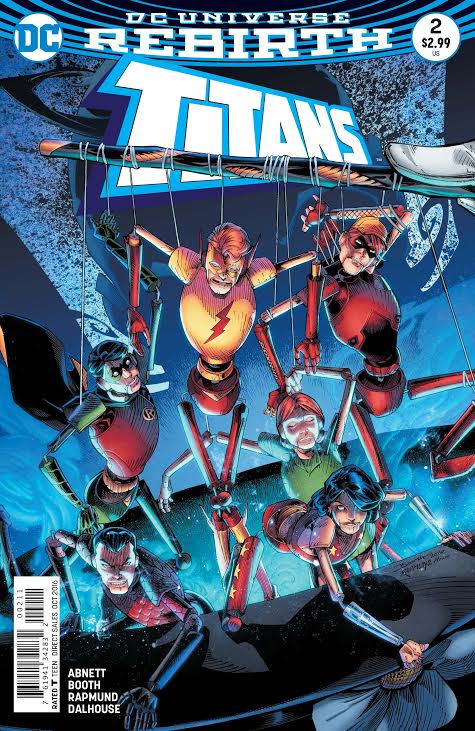
Review: Titans #2


Review: Titans #2
Submitted by: Theresa Stier, Comic News Writer
24 August 2016

“Return of Wally West: Smoke and Mirrors,” by Dan Abnett and artist Brett Booth, is definitely one of my favorite comics I have read this month. The story, the characters, the colors… everything is great! I'm going to do my best not to reveal too many spoilers because I want you all to read this comic. The Titans are forced to fight younger versions of themselves: Nightwing has Robin, Flash has Wally, etc. One of my favorite parts is when the two Flashes meet. The line that Flash says, about not being sure who he has been the past few days (this is said in a joking matter), is something that The Flash would say.

The issue is very action packed and there's definitely more to come in the next issue, which I would like to have right now to see how The Titans take down their past selves, created by Kadabra. What I would also like to talk about is the cover of this issue. Before reading this, I had no idea why this cover was the cover. It was creepy and something that I haven't seen before on a Titans's comic. After reading, the cover makes sense: it's still creepy, but it makes sense. Please do not judge the cover of this comic and read it! It's definitely worth the read, at least I think so.

The Verdict: I need the next issue ASAP! Everything from the colors to the story line is excellent. If you're a fan of The Titans, you need to read this comic. If you're not a fan of The Titans, you need to read this comic. Bottom line: everyone needs to read this comic!